Disruption in Detroit by Daniel J. Clark
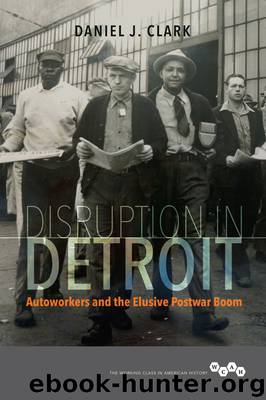
Author:Daniel J. Clark
Language: eng
Format: epub
Publisher: University of Illinois Press
Published: 2018-02-17T16:00:00+00:00
7“A Severe and Prolonged Hangover,” 1956–1957
Although automakers voiced optimism that the banner year of 1955 would become the norm, layoffs increased in early 1956, largely because nearly a million of the record number of vehicles produced had yet to be sold by dealers. As a result, auto companies scaled back production. SUB benefits, at the heart of the 1955 contract settlements, were of little help, because the programs were not fully funded and most unemployed autoworkers could not meet eligibility requirements. Instead they struggled, as always, to cobble together secondary support systems. Making matters worse, many laid-off autoworkers had gone into debt during flush times in 1955 and were now saddled with mortgages, rents, or installment payments without regular income. Although automation continued to affect overall employment, it played a less noticeable role given the vast unemployment caused by overproduction in 1955, the demise of more parts manufacturers, the loss of remaining Packard jobs, and the continued threat of decentralization of the industry away from Detroit. Throughout 1956 and 1957, Detroit floundered while the national economy thrived. More accurately, Detroit’s working-class residents suffered from unemployment as well as insecurity on the job caused by the ripple effects of layoffs. Wealthier Detroiters shared in the nation’s prosperity by shopping intensely at leading downtown department stores while many businesses in autoworkers’ neighborhoods faced bankruptcy. State, local, and UAW officials pleaded for help from the federal government, but none was forthcoming. Federal officials and automakers saw no need for government intervention and blamed autoworkers, with their high wages and generous fringe benefits, for their own predicament. In late 1957 economists declared an official recession, and the rest of the nation began to face what Detroit’s industrial workers had long experienced.
* * *
In early 1956 the warning signs of the previous year proved accurate, as production cutbacks and layoffs accelerated in Detroit’s auto plants. The first to be let go had been hired in the 1955 boom, followed by waves of those who had become autoworkers in the 1953 upturn. Ford’s Mercury Division cut 2,450 workers, including 700 at its Wayne plant. Among the newly jobless at that facility was Thomas Nowak, who had hired in during the 1955 boom after trying without success to be an autoworker throughout 1954. He had no idea if he would ever be recalled. Placing the layoffs in perspective, Mercury officials noted that after these cuts the division still had nearly 19,000 employees, 4 percent more than were on its payroll in January 1955.1 Many autoworkers who were not on layoff were affected as well by the return of short time, for example three- and four-day weeks at Ford, and random total shutdown days at Chrysler. GM president Harlow Curtice was quick to dismiss speculation that the industry was returning to the doldrums, insisting to banking and industrial elites that 1956 would be “another big year.” At least 7.5 million vehicles would be produced, he claimed, and there was “every indication that full employment will continue.” These were bold predictions, especially since over eight hundred thousand cars built in 1955 remained unsold.
Download
This site does not store any files on its server. We only index and link to content provided by other sites. Please contact the content providers to delete copyright contents if any and email us, we'll remove relevant links or contents immediately.
The Brazilian Economy since the Great Financial Crisis of 20072008 by Philip Arestis Carolina Troncoso Baltar & Daniela Magalhães Prates(365159)
International Integration of the Brazilian Economy by Elias C. Grivoyannis(111612)
The Art of Coaching by Elena Aguilar(53668)
Flexible Working by Dale Gemma;(23362)
How to Stop Living Paycheck to Paycheck by Avery Breyer(19837)
Thinking, Fast and Slow by Kahneman Daniel(12537)
The Acquirer's Multiple: How the Billionaire Contrarians of Deep Value Beat the Market by Tobias Carlisle(12433)
The Radium Girls by Kate Moore(12189)
The Art of Thinking Clearly by Rolf Dobelli(10721)
Hit Refresh by Satya Nadella(9263)
The Compound Effect by Darren Hardy(9168)
Tools of Titans by Timothy Ferriss(8600)
Atomic Habits: Tiny Changes, Remarkable Results by James Clear(8524)
Turbulence by E. J. Noyes(8219)
A Court of Wings and Ruin by Sarah J. Maas(8120)
Change Your Questions, Change Your Life by Marilee Adams(7938)
Nudge - Improving Decisions about Health, Wealth, and Happiness by Thaler Sunstein(7862)
How to Be a Bawse: A Guide to Conquering Life by Lilly Singh(7617)
Win Bigly by Scott Adams(7350)
